
Publication Laka-library:
Shopping for arguments: reconstructing debate pros & cons of nuclear energy (2006)
| Author | TU Wageningen |
| Date | June 2006 |
| Classification | 1.01.1.40/21 (OPINION - CIVIL SOCIETY) |
| Front | 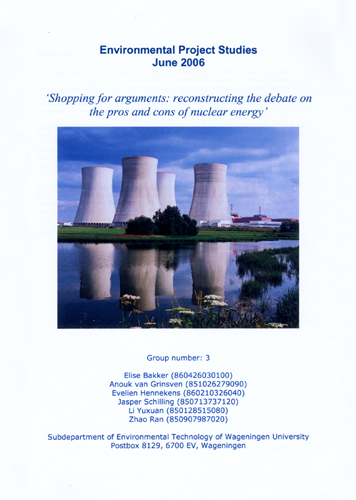 |
From the publication:
1. Introduction

With a rapid development of the social economic state and the industry of the
world, there are more and more environmental problems emerging these days.
For instance, carbon emission levels continue to rise due to electricity generation,
air travel and car usage. The most emphasized issue is whether the emissions of
greenhouse gases can be stopped before the depletion of the energy or not (RIVM,
2000). This higher energy consumption would not have been a problem in the case
that this energy was derived from sustainable processes in the last century.
However, the energy structure of the world today is that fossil fuels like natural gas
and coal are still the most important energy sources and that only a small fraction
comes from sustainable sources like solar and wind energy. Energy uses (industrial,
refineries, electricity production, heating of buildings and transport fuels) are
responsible for the large amount of emission of greenhouse gases, with
3,210 million tons in 2000 (European economic and social committee). In the
Netherlands, natural gas is the main resource, together with coal and raw oil. Table
1.1 shows the amounts of energy produced in the Netherlands by the different
sources.

Table 1.1. Sources of energy in 2005 in the Netherlands (Pleijsier L, 2006)
Source                                                       Amount of energy produced (PJ)
coal and coal product                                240PJ
natural gas                                                 420PJ
nuclear energy                                            40PJ
petroleum                                                   38 PJ
biomass                                                      30PJ

To come to minimize emission of greenhouse gases like C02 and to get alternative
energy instead of current fossil fuels, which will be exhausted someday, we have
to  search for an alternative energy that does not emit C02. Furthermore, this energy should be produced as sustainable as possible what means sustainable according to
the Brundlandt report (see subchapter 1.4 on Definitions). In the case of Brundlandt,
CO2 neutral would be the ideal situation. The energy intensity of nuclear energy is
one million times higher than that of fossil fuels and nuclear energy, unlike coal and
natural gas and other fossil fuels, does not produce CO2 as by-product. On a global
scale nuclear power currently reduces carbon dioxide emissions by 2.4 billion
tonnes per year (equivalents to the main alternative of coal-fired generation, about
2 billion tonnes relative to the present fuel mix) (World Nuclear Association, 2006), but some problems like for instance nuclear waste and the safety-risks are associated with  nuclear energy.
This publication is only available at Laka on paper, not as pdf.
You can borrow the publication or request a copy. When we're available, this is possible for a small fee.