
Publication Laka-library:
Annual report 1993. Operation of the High Flux Reactor (1994)
| Author | Joint Research Centre Petten |
| Date | 1994 |
| Classification | 1.01.8.51/17 (PETTEN RESEARCH LOCATION - HFR) |
| Front | 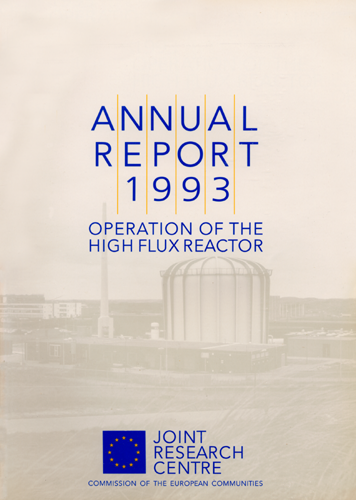 |
From the publication:
INTRODUCTION

The High Flux Reactor (HFR) Petten belonging to the Institute for Advanced
Materials of the Joint Research Centre of the European Communities, is one of
the few high power multi-purpose materials testing reactors still in operation in
Europe.

The HFR is of the tank-in-pool type, it is light-water cooled and moderated, and
it is operated at 45 MW at a prescribed schedule of 11 cycles per year, each
comprising 25 operation days and 3 shut-down days. The reactor provides of a
variety of irradiation possibilities in the reactor core, the reflector region as well
as outside the reactor vessel in so-called poolside facilities. Twelve horizontal
beam tubes are serving a neutron scattering laboratory and a number of other
purposes.

In 1993 a total of 279 operation days were achieved, corresponding to an overall
availability of 76%. The HFR demonstrated again its high reliability with not more
than 8 unscheduled interruptions of regular operation. Occupational dose was kept
at a low level again, and there were no safety related incidents. Apart from a
considerable number of regular maintenance activities, the following upgrading
and modification projects are noteworthy:
- full renovation of the secondary cooling water outlet line which had degraded
due to 30 years of seawater action,
- renewal of the chlorine injection system of the secondary cooling piping as
required by the authorities,
- renewal of the HFR mains power distribution cabinet.

As a matter of high priority, further significant efforts were made with regard to
quality assurance towards safe and efficient operation of the reactor which in
itself is an explicit programme objective.

In the year 1993, the HFR has continued to serve a remarkably broad users
community. The exploitation programme encompassed fission reactor technology
with fuel and structural materials investigations, the technology of materials for
thermonuclear fusion with damage studies on all kinds of structural materials as
well as performance testing of blanket breeder materials, it also encompassed -
though at a reduced level - fundamental research with neutrons, and, as a steeply
increasing activity, large scale radioisotope production mainly for medical
applications; neutron activation analysis, neutron radiography and other
irradiation services were offered as well; lastly, research towards cancer therapy
with neutrons, known as Boron Neutron Capture Therapy or BNCT, was
successfully continued. The irradiation capacity of the HFR was used at a rate of
60% (63% in 1992).

The sectorial breakdown of the HFR utilization shows a further remarkable decrease
of nuclear energy related programmes, whereas radioisotope production, mainly
for the medical sector, has experienced another significant increase, a fact which
clearly demonstrates that high power research reactors are of paramount
importance for supporting nuclear medicine.
This publication is only available at Laka on paper, not as pdf.
You can borrow the publication or request a copy. When we're available, this is possible for a small fee.