
Publication Laka-library:
La centrale de Creys-Malville
| Author | NERSA |
| Date | |
| Classification | 2.02.8.20/06 (FRANCE - SUPERPHÉNIX - GENERAL) |
| Front | 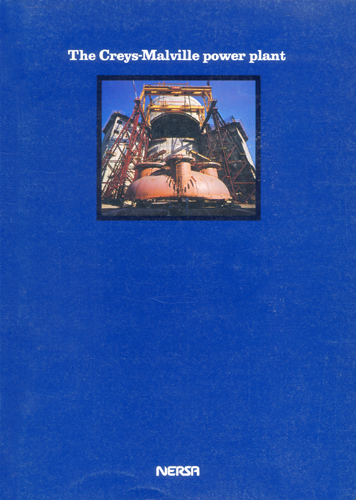 |
From the publication:
Introduction

Fast breeders : a gamble

Nuclear energy is the energy released in the form of heat when the atomic nucleus
of fissile materials such as uranium 235 or plutonium 239 are split by a neutron. It
corresponds to the difference in binding energy between the elementary particles
constituting the fissile nuclei and the total binding energies of the particles
constituting the fission products. This explains why the energy captured (200 MeV
per split nucleus) is approximately the same, independently or whether uranium or
plutonium is used. Due to the internal stability of these nuclei, the fission products
are in fact always situated in the same areas of the Mendeleev table and their binding
energies approximately the same, as in the case of the original nuclei.

Natural uranium contains 99.3% uranium 238, but only 0.7% uranium 235. Uranium
235 is easily split by neutronic bombardment, whereas uranium 238 is not. It does,
however, readily absorb neutrons (those, at least, of sufficient energy), thereby
creating a new body called plutonium 239, which in turn can be split when colliding
with another neutron. When natural uranium is used directly (in BWR reactors, for
example), or is enriched up to 3% uranium 235 (as in the PWR reactors), most of the
uranium 235 is used up, together with a small part of the uranium 238, which has
been converted into plutonium 239. If, however, the weight of material used up is
compared to the weight of the original natural uranium, this represents roughly1 %.
The remainder is made up of unrecoverable scrap, i.e. uranium with a depleted
U 235 content of about 0.2%.

France went over to nuclear energy in order to diversify its fuel sources and ease
the foreign trade deficit by replacing some totally oil-based fuel requirements by
uranium, a raw material of lesser cost, available domestically in large quantities.
After a preliminary stage in which magnox power plants such as Chinon,
St. Laurent and Bugey were built, E.D.F. decided to set up an extensive programme
of pressurized water reactors fuelled by uranium enriched to 3% U 235. This
resulted in twenty-one 900 MW e units operational as of October 1st, 1981, with
twelve more under construction; one is planned for 1982, twelve 1300 MWe units
are a firm commitment and six more are planned for1982-1983. The uranium is
enriched in France at the Tricastin plant. Fuel from the magnox reactors is
reprocessed at the Marcoule and La Hague plants and fuel from pressurized water
reactors is reprocessed at La Hague. France has, therefore, access both to the
plutonium extracted from irradiated fuel in its existing power plants and large
quantities of depleted uranium from its enrichment plants.

This is where breeder reactors come into their own, since they will enable use to
be made of the depleted uranium scrap and ensure that most of the potential energy
contained in natural uranium is progressively mobilized.

Uranium 238 is converted into plutonium 239 and used as fuel. In order to do so,
nuclear fuel of a very high fissile material content (approximately 15%-25% in
present reactors - whether plutonium or U 235) has to be used. This dispenses of the
moderator (which, in the case of natural uranium or low enrichment reactors slows
down the neutrons needed to keep the chain reaction going).
This publication is only available at Laka on paper, not as pdf.
You can borrow the publication or request a copy. When we're available, this is possible for a small fee.