
Publication Laka-library:
US agreement prohibits France from militarizing commercial breeder reactor Superphenix (1984)
| Author | D.Albright |
| Date | February 1984 |
| Classification | 2.02.8.20/14 (FRANCE - SUPERPHÉNIX - GENERAL) |
| Front | 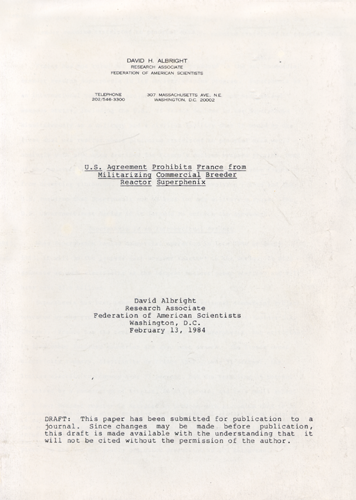 |
From the publication:
France has not ruled out using plutonium produced in the new commercial breeder
reactor Superphenix in its nuclear weapons program. Superphenix is an international
commercial project that involves both non-weapons and weapons states, including
the U.S. If France decided to use Superphenix simultaneously as a military and a
civilian facility then it would be the first dual use reactor where plutonium restricted
to peaceful uses would comingle with plutonium destined for France's nuclear
weapons program. Most of the relevant international agreements and treaties cannot
stop France from diverting plutonium. However, an agreement involving France and
the U.S. requires that Superphenix not be used for any military purpose. The U.S.
Government must decide if it intends to enforce the agreement.

Superphenix is an International Project
When Superphenix begins commercial operation in late 1984 or early 1985, it will
be the largest fast breeder reactor* in the world. It will generate as much electricity
as the largest nuclear power stations and will have cost $2.4 billion.
Superphenix has been constructed by an international commercial project operated
by the French company, Centrale Nucleaire a Neutrons Rapides S.A. (Nersa). France
has the controlling interest in Superphenix, but utilities in five other European
countries are also part owners. The French owned electricity company, Electricite
de France (EdF), owns 51 percent, the Italian electricity, company owns 33 percent,
and the remaining 16 percent is shared by a consortium of Belgian, Dutch, German,
and to a small extent…

* A fast breeder reactor is designed to produce more plutonium than it it consumes.
The core, which contains fuel composed of plutonium and uranium, is surrounded by
a blanket, which contains uranium. During the operation of the reactor, neutrons from
the fissioning of plutonium in the fuel irradiate uranium in the fuel and in the blanket
and produce new plutonium. The fuel in the initial core of Superphenix contains 5.5
metric tons of plutonium and the net yearly plutonium production is 200 kilograms.
This publication is only available at Laka on paper, not as pdf.
You can borrow the publication or request a copy. When we're available, this is possible for a small fee.