
Publication Laka-library:
Non Nuclear energy Options for the UK (1980)
| Author | SERA |
| Date | July 1980 |
| Classification | 2.05.0.00/43 (UNITED KINGDOM - GENERAL) |
| Front | 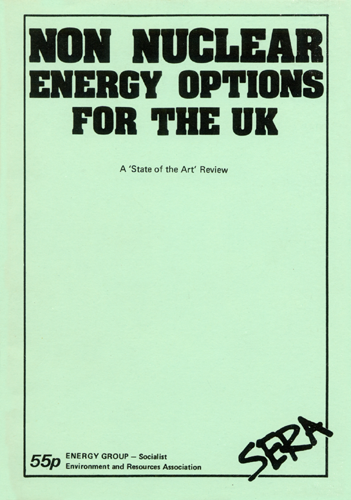 |
From the publication:
Introduction

The debate about British energy policy goes ahead on a number of different levels;
technical, political, economic and ethical. One of the disturbing features of this is
that often one of these areas is taken to be of such obvious priority that it is felt
nothing need be said of the others. The dangers of nuclear weapon proliferation, for
example, are sometimes seen to be so obvious that argument about the comparative
costs of nuclear power is dismissed as materialist trivia. On the other hand, the
assumption of economic primacy, that what matters is jobs and income growth,
and all else is intellectual hot air, is also widespread.
This pamphlet is written from a particular and a committed position; that the further
growth of nuclear power is both dangerous and wasteful and should be prevented.
But it is also written in the belief that opposition to nuclear power in this country has
failed to achieve mass support largely because it has failed to break out of the largely
negative position of being 'anti-nuclear'. However, wrong-headedly, many people in
this country see nuclear power as, in some sense, representing progress and the
onward march of technology. This is particularly true of trade unionists who see,
quite reasonably, unemployment as the major social evil of this country and who
link together economic growth, technology and, by· implication, nuclear power as
the way to lower unemployment. The fact that in 1977 the TUC passed a resolution
supporting the Fast Breeder* with virtually no dissension, results primarily from this
identification.
The tasks of this pamphlet are to discuss the alternatives to nuclear power in terms of
the positive economic advantages they have, not just because of a better environment
but because they embody a potential for new jobs and an expanding technology. The
point to be made is that a commitment to a Fast Breeder involves spending more
investment resources and devoting more skilled labour than any other industrial
project ever undertaken in Britain. More than Concorde; more than the British Steel
Corporation investment plan recently slashed by the government; far more than to
British Leyland. All for a process whose technical feasibility is unproven at a
commercial scale, and regarded as doubtful by many engineers; which offers no
substantial long-term employment opportunities and which will tend to reduce
employment in the mining industry; which offers little or no export potential except
under conditions which would increase dramatically the possibility of nuclear war;
which will absorb a large amount of engineering and scientific talent. Even if the
health and safety aspects are ignored, the project would be a disaster.
The bones of these assertions are virtually conceded even by supporters of the Fast
Breeder. Although naturally they express them in rather muted tones, no one
seriously defends the economics of the Fast Breeder nor its industrial prospects.
Instead the big drums have been banging steadily for the past year in a carefully
orchestrated stream of opinions that, like it or not, there is no alternative. Sir Alan
Cottrell, former Chief Scientific Advisor (and thus a 'big noise') says that "there is
no technical or economic alternative to the FBR". The science and industry
correspondents are carefully briefed by the fulltime Atomic Energy Authority (AEA)
team now devoted to preparing the public relations campaign. And opponents,
having shown their hands at the Windscale Inquiry, are having their arguments
either belittled or outflanked.

*A Fast Breeder reactor is the next generation of nuclear power which reduces the
dependence on natural uranium but produces large amounts of plutonium.
This publication is only available at Laka on paper, not as pdf.
You can borrow the publication or request a copy. When we're available, this is possible for a small fee.