
Publication Laka-library:
Report on the NIREX internal inquiry. January-December 2000 (2001)
| Author | Murray, Wild, Millard |
| Date | July 2001 |
| Classification | 2.05.4.10/57 (UNITED KINGDOM - WASTE - NIREX/NDA DECOMMISIONING) |
| Front | 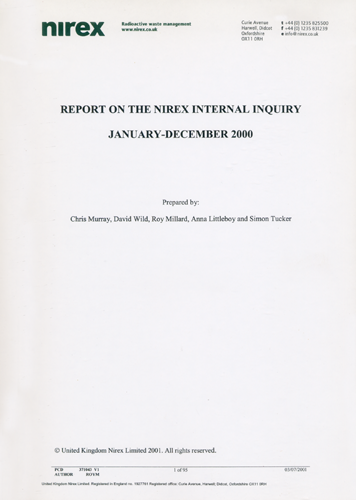 |
From the publication:
1 INTRODUCTION

One of the main tasks Nirex undertook after planning permission for a Rock
Characterisation Facility at its Sellafield site was refused in March 1997 was to try
to learn the lessons of that failure. These lessons suggest that the processes required
to deal with such a contentious issue, the conduct of individuals and the structural
relationship between organisations all need to change if any progress is to be made.
Nirex believes that central to these changes needs to be a strong ethical framework
based on transparency.

One of the first outputs from the analysis of the lessons was Nirex's June 1998
Transparency Policy (Appendix A). Since then Nirex has continued to develop and
implement changes to its culture, behaviours and procedures (including the adoption
of a "whistleblower policy" - "Raising and Sharing Concerns at Work", Appendix B)
to try and live up to the stated aims in that policy.

It is in the light of this Transparency Policy that Nirex has undertaken an Internal
Inquiry, of its own volition, during 2000, into allegations made against the
Company. These are detailed in Appendix C.

Nirex staff members formed the Internal Inquiry team, which investigated the
allegations. The Nirex Board appointed Lynda Warren, Professor of Environmental
Law at the University of Wales, as an external assessor. Her terms of reference are
detailed in Appendix D. Advice was given by Guy Dehn, Director of 'Public
Concern at Work' and legal advice was taken from Slaughter and May. The
methodology adopted by the Internal Inquiry team is given in Appendix E.

This report presents the findings of the Internal Inquiry. A number of allegations
have been substantiated, most are not. The detailed findings from each individual
investigation of 52 allegations about Nirex and, in particular, the conduct and
reporting of its Scientific programme are presented in the main body of the report.

Although most of the allegations could not be substantiated, the Inquiry process did
highlight a number of lessons that Nirex believes it must recognise and implement.
The emphasis throughout the investigation has been to try to look honestly at the
ast and to draw lessons rather than conduct a witch-hunt. In this way it is hoped
that the process will be constructive rather than destructive.

To put the lessons from the Internal Inquiry into context, a strategic analysis was
carried out comparing the results of the investigation with the general lessons
learned following refusal of planning permission for the RCF in 1997. This analysis
is reported in Section 2. General conclusions and recommendations from the
Inquiry Team are given in the final part of the report.
This publication is only available at Laka on paper, not as pdf.
You can borrow the publication or request a copy. When we're available, this is possible for a small fee.