
Publication Laka-library:
Liquidation of the consequences of chemical extraction of uranium in Stráz pod Ralskem, Czech Republic (2005)
| Author | |
| Date | October 2005 |
| Classification | 2.39.0.00/03 (CZECH REPUBLIC - GENERAL) |
| Front | 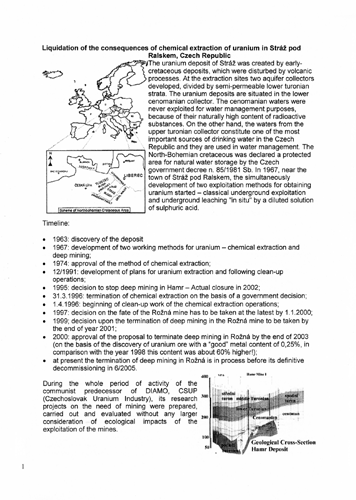 |
From the publication:
Liquidation of the consequences of chemical extraction of uranium in Stráž pod
Ralskem, Czech Republic Stráž

The uranium deposit of Stráž was created by early-cretaceous deposits, which were
disturbed by volcanic processes. At the extraction sites two aquifer collectors
developed, divided by semi-permeable lower turonian strata. The uranium deposits
are situated in the lower cenomanian collector. The cenomanian waters were never
exploited for water management purposes, because of their naturally high content of
radioactive substances. On the other hand, the waters from the upper turonian
collector constitute one of the most important sources of drinking water in the Czech
Republic and they are used in water management. The North-Bohemian cretaceous
was declared a protected area for natural water storage by the Czech government
decree n. 85/1981 Sb. In 1967, near the town of Stráž pod Ralskem, the
simultaneously development of two exploitation methods for obtaining uranium
started - classical underground exploitation and underground leaching "in situ"
by a diluted solution of sulphuric acid.
This publication is only available at Laka on paper, not as pdf.
You can borrow the publication or request a copy. When we're available, this is possible for a small fee.