
Publication Laka-library:
Risk Assessment Review Group report to USNRC (NUREG/CR-0400) (1978)
| Author | Lewis, Ad Hoc Review Group |
| Date | September 1978 |
| Classification | 3.01.0.20/25 (UNITED STATES - SAFETY) |
| Front | 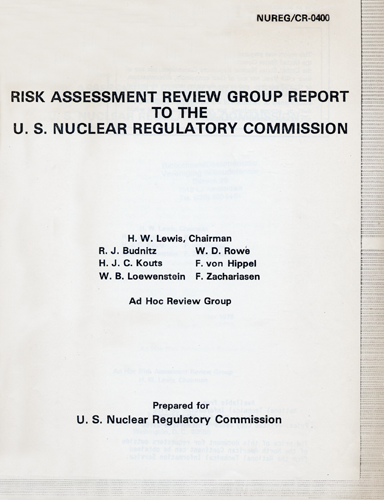 |
From the publication:
SUMMARY

The Risk Assessment Review Group was organized by the U.S. Nuclear
Regulatory Commission on July 1, 1977, with four elements to its charter:

(l) Clarify the achievements and limitations of WASH-1400, the
"Rasmussen Report."*

(2) Assess the peer comments thereon, and responses to those comments.

(3) Study the present state of such risk assessment methodology.

(4) Recommend to the Commission how (and whether) such methodology can
be used in the regulatory and licensing process.

The group was formed to represent a wide spectrum of views about nuclear safety,
though each member was chosen for his technical expertise. We have profited from
a year of study and testimony, and wish to acknowledge the outstanding cooperation
we have received from the staff of the Nuclear Regulatory Commission, the nuclear
industry, and concerned scientists and citizens.

We find that WASH-1400 was a conscientious and honest effort to apply the methods
of fault-tree/event-tree analysis to an extremely complex system, a nuclear reactor,
in order to determine the overall probability and consequences of an accident. We have
reviewed the methodology, the data base, the statistical procedures, and the results.

We have found a number of sources of both conservatism and nonconservatism in
the probability calculations in WASH-1400, which are very difficult to balance.
Among the former are inability to quantify human adaptability during the course of
an accident, and a pervasive regulatory influence in the choice of uncertain
parameters, while among the latter are nagging issues about completeness, and an
inadequate treatment of common cause failure. We are unable to define whether the
overall probability of a core melt given in WASH-1400 is high or low, but we are
certain that the error bands are understated. We cannot say by how much. Reasons
for this include an inadequate data base, a poor statistical treatment, an
inconsistent propagation of uncertainties throughout the calculation, etc.

Also, both the dispersion model for radioactive material and the biological effects
model should be improved and updated before they are applied in the regulatory
and licensing process.

* U.S. Nuclear Regulatory Commission, Reactor Safety Study: An Assessment of
Accident Risks in U.S. Commercial Nuclear Power Plants, WASH-1400
(NUREG-75/014), October 1975. Available from National Technical
Information Service, Springfield, VA 22161.
This publication is only available at Laka on paper, not as pdf.
You can borrow the publication or request a copy. When we're available, this is possible for a small fee.