
Publication Laka-library:
Public opposition to nuclear energy (1980)
| Author | Kasperson |
| Date | April 1980 |
| Classification | 3.01.2.19/01 (UNITED STATES - ANTI NUCLEAR MOVEMENT / ACTIONS / REPRESSION) |
| Front | 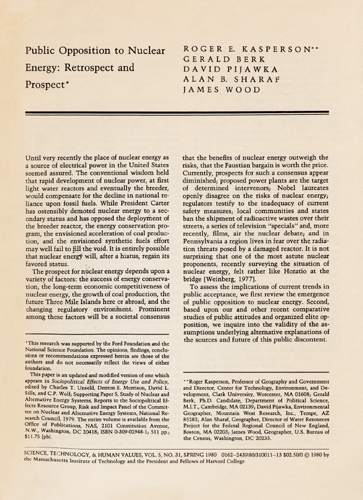 |
From the publication:
Public Opposition to Nuclear
Energy: Retrospect and
Prospect*

Until very recently the place of nuclear energy as a source of electrical power in the
United States seemed assured. The conventional wisdom held that rapid development
of nuclear power, at first light water reactors and eventually the breeder, would
compensate for the decline in national reliance upon fossil fuels. While President
Carter has ostensibly demoted nuclear energy to a secondary status and has opposed
the deployment of the breeder reactor, the energy conservation program, the
envisioned acceleration of coal production, and the envisioned synthetic fuels effort
may well fail to fill the void. It is entirely possible that nuclear energy will, after
a hiatus, regain its favored status.
The prospect for nuclear energy depends upon a variety of factors: the success of
energy conservation, the long-term economic competitiveness of nuclear energy,
the growth of coal production, the future Three Mile Islands here or abroad, and the
changing regulatory environment. Prominent among these factors will be a societal
consensus that the benefits of nuclear energy outweigh the risks, that the Faustian
bargain is worth the price. Currently, prospects for such a consensus appear
diminished; proposed power plants are the target of determined intervenors; Nobel
laureates openly disagree on the risks of nuclear energy; regulators testify to the
inadequacy of current safety measures; local communities and states ban the shipment
of radioactive wastes over their streets; a series of television "specials" and, more
recently, films, air the nuclear debate; and in Pennsylvania a region lives in fear over
the radiation threats posed by a damaged reactor. It is not surprising that one of the
most astute nuclear proponents, recently surveying the situation of nuclear energy,
felt rather like Horatio at the bridge [Weinberg, 1977].
To assess the implications of current trends in public acceptance, we first review the
emergence of public opposition to nuclear energy. Second, based upon our and other
recent comparative studies of public attitudes and organized elite opposition, we
inquire into the validity of the assumptions underlying alternative explanations of
the sources and future of this public discontent.

*This research was supported by the Ford Foundation and the National Science
Foundation. The opinions, findings, conclusions or recommendations expressed
herein are those of the authors and do not necessarily reflect the views of either
foundation.
This paper is an updated and modified version of one which appears in Sociopolitical
Effects of Energy Use and Policy, edited by Charles T. Unseld, Denton E. Morrison,
David L. Sills, and C.P. Wolf, Supporting Paper 5, Study of Nuclear and
Alternative Energy Systems, Reports to the Sociopolitical Effects Resource Croup,
Risk and Impact Panel of the Committee on Nuclear and Alternative Energy Systems,
National Research Council, 1979. The entire volume is available from the Office of
Publications, NAS, 1101 Constitution Avenue, N.W., Washington, DC 204181 ISBN
0·309-o1948·11 511 pp., $11.75 (pb).
This publication is only available at Laka on paper, not as pdf.
You can borrow the publication or request a copy. When we're available, this is possible for a small fee.