
Publication Laka-library:
Get Up, Stand up. A manual for the anti-nuclear defendant (1982)
| Author | Abolone Alliance |
| Date | 1982 |
| Classification | 3.01.2.19/06 (UNITED STATES - ANTI NUCLEAR MOVEMENT / ACTIONS / REPRESSION) |
| Front | 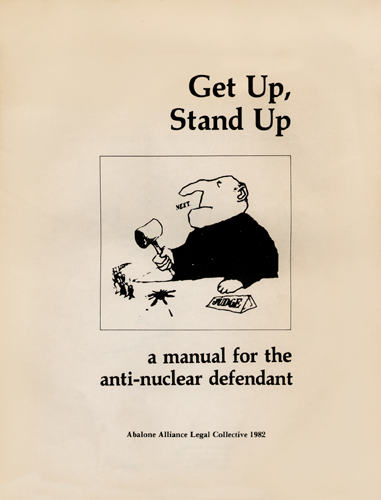 |
From the publication:
Preface

The relationship between the anti-nuclear movement and the legal system has often
been fraught with controversy. There are as many views on how the system should
be used, or avoided, as there are activists. Once you have made the decision to
present a defense, you have a choice of being represented by an attorney or
representing yourself. Representing yourself is call "going pro per" (in California)
or "going
pro se" in other states.
This manual has been written to assist people who have made the decision to
represent themselves in court. It was written by members of the Abalone Alliance
Legal Collective originally to serve those who demonstrated against the Diablo
Canyon nuclear power plant in San Luis Obispo, California.
Although Get Up, Stand Up was written with the Diablo Canyon actions in mind,
we believe that it is applicable to other activities involving the risk of arrest. It
can be useful to many people working for social change- from those resisting
oppression of sexist and racist institutions, to people protesting nuclear technology.
The manual's goal is to provide a framework for people who are representing
themselves in misdemeanor arrest situations. FELONY ARRESTS ARE NOT
COVERED. If you are charged with a felony, we recommend that you talk with an
attorney immediately. Felony situations are likely to involve more complex legal
knowledge, and the ramifications of such charges are significantly more serious.
Get Up, Stand Up is intended as an introduction to trial procedure. It includes some
political strategies for coping with the legal system. Although most aspects of a trial
are outlined here, it is not mandatory that you master all of the technical material.
Your best course in the courtroom is to rely upon common sense. After all, common
sense is what binds you to the jurors, and separates your defense from one prepared
by lawyers. Hopefully, this booklet will provide you with information that will be
helpful when, for example, the District Attorney attempts to confound you with
technical objections as you are questioning a witness.
In suggesting strategies for developing your case, California law is cited throughout
the manual. The general methods of trial procedure in most states differ only in
detail. However, if you are relying on a technical point of California law for a case
in another state, you should investigate the applicable laws in that state.
Obtaining technical advice can lead to another area of concern; the relationship
between movement activists and the experienced legal community. Biases exist
on both sides. Lawyers and legal workers tend to speak in jargon which is
unfamiliar to people outside the legal community. Legal options may be presented
as ultimatums and defendants may feel that they have no choice but to accept the
strategy or conclusion of the skilled legal worker. At the same time, activists can
disregard the skills offered by the legal community, often to their own detriment.
The best preparation for representing your case is to know your goals and to feel
confident about your own decisions. Legal people can give you information on the
law and the benefit of their experiences in the courtroom, both of which may be
useful to you.
Another tension which may arise concerns the motivations of movement people
in contrast to the orientation of legal people. Many legal workers have difficulty
understanding that what may be legally prudent is contrary to the political or
philosophical commitments of activists. Activists may fail to communicate to
lawyers and legal workers that desire to challenge the system on other than legal
grounds-while still utilizing the legal system to present those challenges.
This publication is only available at Laka on paper, not as pdf.
You can borrow the publication or request a copy. When we're available, this is possible for a small fee.