
Publication Laka-library:
Strange victories. The anti-nuclear movement in the U.S and Europe (1979)
| Author | Midnight Notes Collective |
 | 3-01-2-19-17.pdf |
| Date | April 1979 |
| Classification | 3.01.2.19/17 (UNITED STATES - ANTI NUCLEAR MOVEMENT / ACTIONS / REPRESSION) |
| Front | 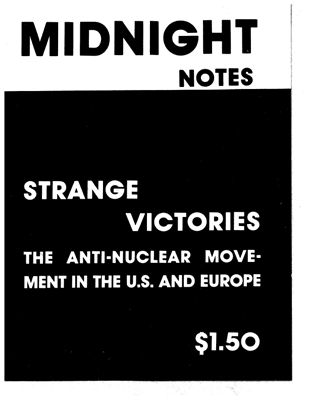 |
From the publication:
Strange victories. The anti-nuclear movement in the U.S and Europe
Midnight Notes Collective
April 26, 1979


Strange Victories is the first of a series of pamphlets to be published by the
Midnight Notes Collective to discuss the capitalist crisis and the form of working
class response to it. The members of our collective come from different
backgrounds and nationalities and have been involved in various political
struggles against work including the anti-war, anti-nuclear, prisoner, men's
and student movements. With Midnight Notes we hope to contribute to the
discussion which is increasingly urgent in the movement concerning the new
direction and organizational form our struggle must take. The following members
of the collective have collaborated on this issue: Hans Widmer, George
Caffentzis, Monty Neill, john willshire, Vasilis Passas.

(...)
What can we do against this politics of fear and exploitation? First, we
have to reject this crisis mentality they want to impose on us. We must
know that there is enough energy, enough money (in 1978 the capitalists
made record profits of $130.7 billion), enough food, clothing and housing
for everybody, employed or unemployed, waged or unwaged. And if problems of
energy conservation arise, we must make sure that the people themselves
control such measures and that they are not dictated to us by the energy-
capitalists in order to make more money. Before we can speak of energy
conservation, we must have more power.

Higher prices and radioacti%ity hit everybody everywhere: blacks,
hispanics and urban whites as well as farmers, small-town residents and
atomic workers around nuclear plants. This fact is crucial for the future
development of the anti-nuclear movement which started in semi-rural and
suburban areas. This movement was a first response of concerned people
against nuclear development. This antinuclear movement is a social movement
with its specific type ot people involved, with its specific ideology,
tactics and experiences. Now that the situation is changing, that "Everybody"
is hit by the nuclear issue, the experiences of the movement must be studied
and--if necessary--criticized. It is important both for "old" anti-nuclear
militants and for "new" people in urban areas who are entering mobilizations
against nuclear energy to find out if and how the anti-nuclear movement can
play a role in our struggle against the power of capital.

In the case of the anti-nuclear movement, there is a risk that it could be
used against poor urban people. As long as the anti-nuclear movement does not
clearly attack the pricepolicies of the energy companies and does not link
the "health " and "money" issues, it cannot be understood by people who are
struggling for daily survival. In such a situation capital can play the anti-
nuke movement against the poor or vice versa. For example, the energy
companies and the state (the government) can blame the anti-nuclear movement
for the higher electric bills; or they can try to impose solar energy and
higher energy prices.

We write this paper because we are convinced that the anti-nuclear movement
in general and the "new" anti-nuclear movement in urban areas in particular
could be a catalyst for struggles against the "crisis" and capitalism's
attack against the working class. Now the most urgent problem is: How can we
organize against capital? In attempting to answer this question, we shall
look at the anti-nuclear movement as a movement of social organization,
determined by the class interest of the people involved in it, by its
relationship to capital, its historical, geographical and psychological
conditions.