
Publication Laka-library:
Defense Nuclear Facilities Safety Board: Activities 1993 (1994)
| Author | DNFSB |
| Date | February 1994 |
| Classification | 3.01.3.12/07 (UNITED STATES - PROLIFERATION POLICY - NUCLEAR WEAPONS & TESTS) |
| Front | 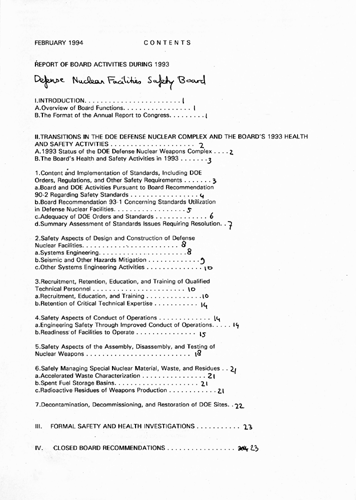 |
From the publication:
INTRODUCTION

A.OVERVIEW OF BOARD FUNCTIONS

The defense nuclear complex was operated by the Department of Energy (DOE) for
decades without independent external oversight. Because of the increasing number
of public health and safety issues that accumulated at aging defense nuclear facilities,
Congress determined that external oversight of those facilities was necessary.
Congress created the Defense Nuclear Facilities Safety Board (Board) in 1988 as an
independent oversight organization within the Executive Branch to provide advice
and recommendations to the Secretary of Energy regarding public health and safety
at DOE's defense nuclear facilities. The President nominated the initial five members
of the Board in the summer of 1989, and the Senate confirmed those nominations in
 October of that same year. This is the Fourth Annual Report provided to Congress
by the Board, and it covers activities during calendar year 1993. Broadly, the Board
reviews operations, practices, and occurrences at DOE's defense nuclear facilities
and makes recommendations to the Secretary of Energy that are necessary to protect
public health and safety.
The Board also as sesses safety management and personnel effectiveness both within
DOE and the various operation and management (O&M) contractor organizations. If,
as a result of its reviews, the Board determines that art imminent or severe threat to
public health or safety exists, the Board is required to transmit its recommendations
directly to the President, as well as to the Secretaries of Energy and Defense.
The Board's enabling statute; 42 U.S.C. AU 2286, requires the Board to review and
evaluate the content and implementation of health and safety standards, including
DOE's Orders, rules, and other safety requirements, relating to the design,
construction, operation, and decommissioning of DOE's defense nuclear facilities.
The Board must then recommend to the Secretary of Energy any specific measures,
such as changes in the content and implementation of those standards, that the
Board believes should be adopted to ensure that the public health and safety are
adequately protected.
The Board is also required to review the design of new defense nuclear facilities
before construction begins, as well as modifications to older facilities, and to
recommend changes necessary to protect health and safety. Board review and
advisory responsibilities continue throughout the construction, testing, and operation
of new facilities. The Board is authorized to conduct special studies pertaining to
adequate protection of public health and safety at defense nuclear facilities. It may
seek the assistance of the federal agencies, organizations outside the government,
and private experts to discharge its duties.
The Board may conduct investigations, issue subpoenas, hold public hearings, gather
information, conduct studies, establish reporting requirements for DOE, and take
other actions in furtherance of its review of health and safety issues at defense
nuclear facilities. These ancillary functions of the Board and its staff all relate to
the accomplishment of the Board's primary function, which is to assist DOE in
identifying and correcting health and safety problems at defense nuclear facilities.
The Secretary of Energy and contractors at defense nuclear facilities are required to
cooperate fully with the Board.
This publication is only available at Laka on paper, not as pdf.
You can borrow the publication or request a copy. When we're available, this is possible for a small fee.