
Publication Laka-library:
Navajo/Hopi european protest tour 1991 (1992)
| Author | Minewatch |
| Date | 1992 |
| Classification | 3.01.5.10/11 (UNITED STATES - URANIUM MINING) |
| Front | 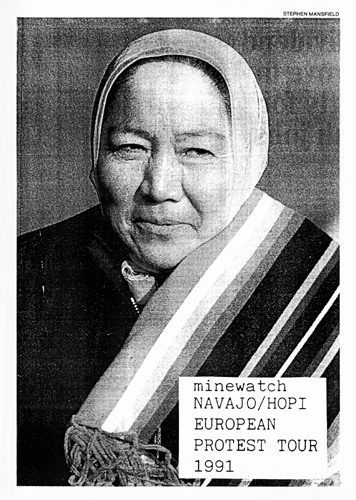 |
From the publication:
INFORMATION FROM MINEWATCH

BACKGROUND DOCUMENTATION TO THE 1991 MINEWATCH NAVAJO/HOPI PROTEST TOUR

Introduction: In January and February 1991 Minewatch sponsored its first tour for
indigenous people affected by mining. The request came from representatives of the
Navajo communities of the Black Mesa region of northeastern Arizona, USA. With
the generous support of The Methodist Church Division of Social Responsibility,
X-minus-Y (Netherlands), The Onaway Trust, and members of Partizans, Minewatch
enabled four Navajo representatives, and Thomas Banyacya of the traditional Hopi,
to address public meetings in London, Newcastle, Glasgow, Dublin, Cambridge,
Reading and Oxford. The delegation also spoke to meetings in Amsterdam and
Munich, and made a verbal address to the United Nations Human Rights
Commission in Geneva. The tour secured a great deal of publicity - some of it
insufferably condescending, though much of it quite accurate: a selection is
included at the beginning of this portfolio.

The issues: The Navajos are the largest tribal nation in mainland USA. Together with
the Hopis, they traditionally farmed a large region of semiarid land in the south-west
of the country. From the late 19th century onwards, however, both their land and their
Treaty rights were inexorably reduced. During the 1960's, as the south-west became
what the US National Academy of Sciences dubbed "a National Sacrifice area":
multinational and domestic energy companies moved in a swathe over Navajo and
Hopi settlements. The "Four Corners" region became the epicentre of oil, gas,
uranium, and in particular, coal exploration.
The largest company involved in coal mining is Peabody Coal; itself probably the
biggest strip miner in the world. Benefitting from give-away leases signed with
"pro-development" tribal councils in the 1960's, Peabody has become the single
greatest threat to Navajo sustainable development, their culture and religious
practice, their water supplies and their health. Peabody Coal company has also
profitted from the widely-condemned US government policy of removals: the
ejection of Navajo families from areas supposedly under Hopi tribal entitlement,
and to a lesser extent the removal of Hopis from areas of Navajo administration.
This publication is only available at Laka on paper, not as pdf.
You can borrow the publication or request a copy. When we're available, this is possible for a small fee.