
Publication Laka-library:
A Handbook on Nuclear Sites in the Great Lakes Region (1999)
| Author | Nuclear Free Great Lakes Act Camp |
| Date | August 1999 |
| Classification | 3.01.8.10/03 (UNITED STATES - SITES - NORTH EAST OTHER) |
| Front | 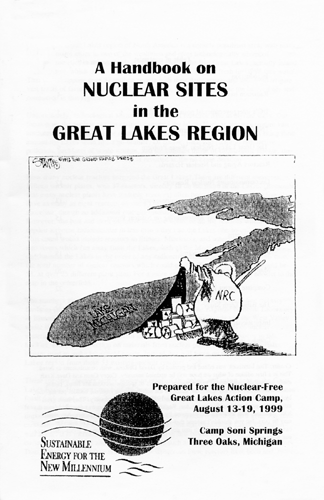 |
From the publication:
The Great Lakes region of North America is a densely populated area, with many
major cities in two of the wealthiest and most technologically advanced societies
in the world. It is centered around the five Great Lakes, actually inland seas which
contain approximately 20% of the world's fresh liquid surface water. That water
supplies over 37 million people with their daily water, and is used to irrigate vast
tracts of farmland. As natural resources go, the Great Lakes are the basis of life
and commerce in this region.

Unfortunately, technological advances threaten that resource base in myriad ways.
Our focus is on the nuclear reactors which surround the lakes. Nuclear reactors
require vast amounts of water, to cool the reactors and to store spent fuel in, which
makes siting them around the Lakes seem like a no-brainer. Of course, once you
factor in radioactive pollution, problems of waste storage, and the constant threat
of catastrophic release, the decision to put them near the Lakes is revealed as the
no-brain decision.

How many nuclear reactors surround the Great Lakes? There are different measures.
Fifteen nuclear plants, with 37 reactors, directly sit on the shore of the Lakes.
(Remember that many nuclear plants have multiple reactors, often two or three;
some Canadian plants have as many as eight reactors on site.) The watershed of
the Lakes extends past the shoreline, though no additional reactors discharge into
rivers which drain into the Lakes. However, the best and most inclusive measure
would be all the reactors which could deposit airborne radionuclides in less than a
day into the Lakes (the so-called "air-shed"). This count would include reactors in
Illinois, Minnesota, and others which may discharge into rivers which run away
from the Lakes, such as the Mississippi, but which could contaminate the Lakes in
the event of any radioactive discharges to the air. In this case, the total number of
nuclear reactors which could easily affect the Lake water would be 53, at over
25 different plant sites. For a more graphic depiction, open this booklet to the map
in the centerfold.

The numbers given above do not include other radioactive sources, including
military facilities (such as the Fernald nuclear plant in Ohio and the Argonne
National Laboratory in Illinois), dumpsites (such as the Espanola tailings site in
Canada and the West Valley waste site in New York), or the much smaller but more
dispersed uses of nuclear materials at hospitals and in civilian industry. We do not
cover these sources in this booklet, except for a section on materials from nuclear
plants entering the materials stream used to make household goods. Instead, we will
focus on the threat to the Great Lakes region from those 53 existing nuclear reactors.
This publication is only available at Laka on paper, not as pdf.
You can borrow the publication or request a copy. When we're available, this is possible for a small fee.