
Publication Laka-library:
A citizen's guide to Rocky Flats (1988)
| Author | Marcia Klotz |
| Date | June 1988 |
| Classification | 3.01.8.44/05 (UNITED STATES - SITES - ROCKY FLATS) |
| Front | 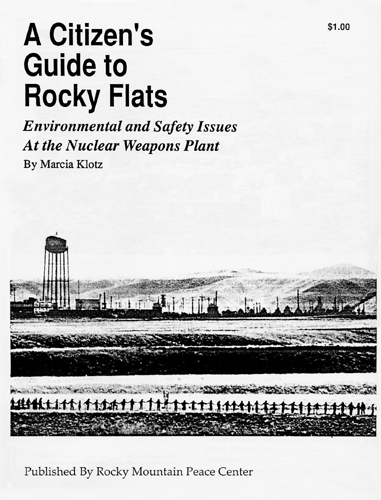 |
From the publication:
A Citizen's Guide to Rocky Flats

"There's Good News Today. U.S. To Build $45 Million A-Plant Near Denver."
This Denver Post headline of March 23, 1951, announced the birth of what was
to become the only plant in the United States to manufacture plutonium triggers
for hydrogen bombs. It also marked the beginning of a highly complex, forced
relationship between a U.S. nuclear facility, the workers who staff it, and more
than a million residents of the nearby metropolitan area.
Mass production of nuclear weapons was a new concept in 1951. The Los Alamos
facility had served both the research and production needs of U.S. nuclear
development up to that time. In order to allow Los Alamos to concentrate strictly
on research, the Atomic Energy Commission (AEC) was developing a complex
of facilities across the nation to build nuclear weapons.
The AEC's criteria for choosing a site included a western location; a dry, moderate
climate; a dependable power source; the proximity of a population of 25,000 or
more; and an attractive environment. Rocky Flats was chosen over 35 other sites.
To avoid a public health risk resulting from a nuclear accident, the AEC needed a
location downwind of any dense population. The Rocky Flats site seemed safe
because wind measurements at Stapleton International Airport showed prevailing
air currents blowing from the south, from Denver towards Rocky Flats. These initial
readings were incorrect. Winds coming from the mountain canyons to the west of
the plant do not follow the same patterns as those at the airport. In general, air
currents leaving Rocky Flats blow to the east or southeast - often towards
downtown Denver. The AEC originally contracted with the Dow Chemical
Company to operate RockyFlats. The facility's contract passed from Dow to
Rockwell International in July 1975. That same year, administrative authority also
shifted from the AEC to the Energy Research and Development Administration
(ERDA). The Department of Energy (DOE) replaced ERDA in 1977 and has
regulated the plant since then.
Rocky Flats has grown significantly since it began full-scale operations in 1953.
The original $45 million price tag mushroomed into construction expenditures of
$250 million. U.S. taxpayers now pay $450 million each year to operate the plant.
Rockwell International's work force has grown to over 5200 (as of February 1988)
from Dow's initial payrollof200. And more than 100 buildings now occupy a site
that started out with only 20 structures.
This publication is only available at Laka on paper, not as pdf.
You can borrow the publication or request a copy. When we're available, this is possible for a small fee.