
Publication Laka-library:
Red light for yellow-cake. The case against uranium mining (1977)
| Author | Hayes, Falk, Barrett |
| Date | March 1977 |
| Classification | 4.22.5.10/10 (AUSTRALIA - GENERAL - GENERAL) |
| Front | 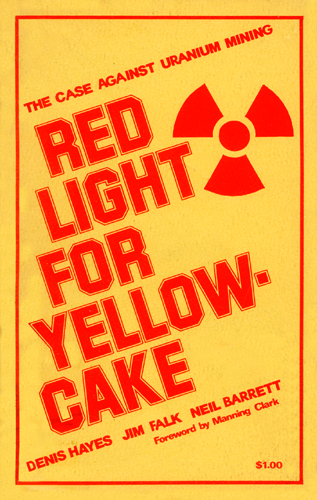 |
From the publication:
FOREWORD

Everyone knows the Australian economy is in a mess: inflation and unemployment
are still with us despite the attempts by the two main political groups, the Labor Party
and the Liberal-National Country Party coalition, to grapple with those two problems.
So when the mining interests announce that there are thirty billion dollars worth of
buried treasure in the form of uranium in Australia, some people grasp at this as a
solution to those problems to which the politicians do not seem to have the answer.

The authors of this book have presented a compelling case against the mining and
export of uranium. They emphasise the conclusions of the Fox Commission that
uranium mining would not create significant economic advantages for most
Australians. However even if it did, they show that the consequences of uranium
mining are so serious that they outweigh any possible material gain. This is not an
argument that is easily made attractive to some people, because they tend to confound
the profitable with goodness and happiness. Nevertheless even such people will find
food for thought in the broad survey of the local and international consequences of
uranium mining carefully documented and presented in layman's language here.

Several local consequences are described. For the Aborigines living in the Top End
of Australia, mining would destroy the physical environment on which they depend
for the survival of their culture and would introduce adverse social effects. Mining
would mean a loss of land for the Aborigines: by losing their land they lose a part
of themselves: they lose that which helps to give a meaning to their lives. For the
miners digging the uranium from the ground, exposure to the radon gas released
would increase their chances of contracting lung cancer. Finally, affecting all
Australians, mining may destroy the unique ecology of the Top End of Australia.

The majority of the book is devoted to explanation of the dangers in the use of
uranium as a fuel for nuclear reactors overseas - the dangers through explosion
or through the leakage of radioactive waste materials, the threat of a rapid spread
of nuclear weapons constructed from nuclear fuels and the dangers inherent in
the expanded police powers necessary to protect the various stages of the nuclear
fuel cycle.

Perhaps the most disturbing point made in the book is that on the question of
uranium mining the truth has been the first casualty. The authors point out that
neither the press nor the politicians seemed capable of telling Australians accurately
what was in the report of the Ranger Commission. For this reason alone this book
should be widely read. The book and the public meeting are two sources of truth in
Australia today. All those who still believe in those two great sayings, great is truth
and it shall prevail and what does it matter if a man gains the whole world but loses
his own soul, will be very grateful to Friends of the Earth for letting us know what is
happening in Australia.

Manning Clark
Emeritus Professor of History
Australian National University
This publication is only available at Laka on paper, not as pdf.
You can borrow the publication or request a copy. When we're available, this is possible for a small fee.