
Publication Laka-library:
American Lake. Nuclear Peril in the Pacific (1986)
| Author | Hayes, Zarsky, Bello |
| Date | 1986 |
| Classification | 4.26.4.00/04 (PACIFIC - US TESTING AREA) |
| Front | 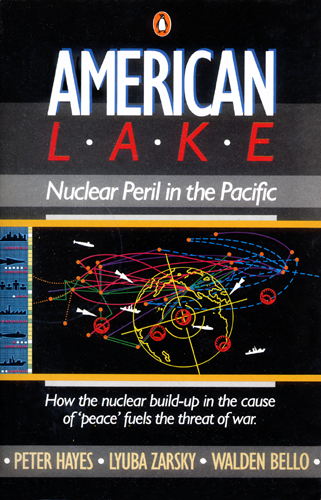 |
From the publication:
INTRODUCTION
NUCLEAR PERIL IN THE PACIFIC

You cannot help but feel that the great Pacific Basin - with all its nations and
all its potential for growth and development - that is the future.
-President Ronald Reagan, August 1984 (1)

The United States has made a fundamental decision that we are a Pacific nation,
and that we will remain a Pacific power and a force for peace and stability in the
region. Our nation's future does indeed lie in the Pacific ... Let no one misread
the past or misjudge our resolve.
-Secretary of Defense Caspar Weinberger, June 1985 (2)

For much of the postwar period, the risk of nuclear war in the Pacific has been
eclipsed by the nuclear threat in Europe. There the super-powers directly confront
each other in a region where both have vital strategic and economic interests.
Echoing and reinforcing the general public perception, most analysts and fictional
accounts have projected that the spark to ignite nuclear conflagration will be struck
in Europe.
But it is just as - perhaps more - likely in coming years that it will be in the
Pacific that global nuclear war is triggered. As in Europe, the superpowers
confront each other "eyeball-to-eyeball" with nuclear weapons in the Far East.
Here, as in Europe, both the United States and the Soviet Union have vital
political, economic, and strategic interests. Indeed, it was in the Pacific, not
in Europe, that the first atomic bomb was exploded in war.
This book demonstrates that the threat of nuclear war in the Pacific is great and
growing. Many sources - political and institutional, as well as technological,
doctrinal, and geographical - pose the peril. First and foremost is the build-up of
large, increasingly lethal and accurate Soviet and American nuclear forces in a
politically volatile area. While Cold War blocs have remained steady in Europe,
they have shifted dramatically in the Pacific. Two major land wars and a host of
bloody insurrections and heavily armed repressive governments have erupted in
less than half a century. Communist, democratic, and nationalist insurgencies, as
well as continuing conflicts between nations, will continue to make the region
politically turbulent into the foreseeable future, heightening the possibility of
superpower interventions. Should their interventions overlap, the superpowers
could clash and escalate to nuclear war.
This publication is only available at Laka on paper, not as pdf.
You can borrow the publication or request a copy. When we're available, this is possible for a small fee.