
Publication Laka-library:
Uranium – A blessing or a curse. Distribution of uranium deposits (2008)
| Author | Earthlife Namibia |
 | 5-63-0-00-19.pdf |
| Date | October 2008 |
| Classification | 5.63.0.00/19 (NAMIBIA - GENERAL) |
| Front | 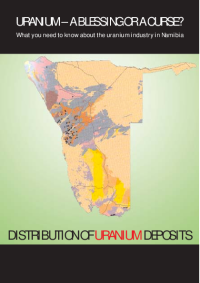 |
From the publication:
Introduction
The energy crisis is the topic of the day, and is closely related to the
phenomenon of climate change. Namibia, being dependent on electricity imports
from South Africa, is facing a serious power crisis. Yet, generating power in a
way that does not exacerbate climate change is a matter not only for Namibia,
but for the whole world.
22 years after the horrifying nuclear accident in Chernobyl, uranium is again
being increasingly mentioned as an alternative source of energy. More than
100 nuclear power plants are panned to be constructed by 2020 in China, India
and Russia alone. However, public relation and reality are two different issues.
The construction of round about 20 nuclear power stations seems to be more
realistic. The Namibian government has also announced its intent to explore
nuclear power generation.
The nuclear chain starts with mining of uranium right here in Namibia and does
not end with the nuclear power plant. The dismantling of old power plants and
storage of nuclear waste create serious problems, with some nuclear waste
remaining radioactive for more than 100,000 years.
Namibia has many uranium deposits and has emerged as a new frontier for
foreign uranium investors. Presently, two uranium mines are operating in the
country (Langer Heinrich Uranium in the protected Namib Naukluft Park and
Rössing Uranium in the Erongo region), and more are expected to open soon.
Is uranium a blessing or a curse for Namibia? Through heated debates,
concerned people try to find an acceptable answer to this question.
Environmentalists and human rights activists see this problem very differently
than politicians and developers.
The aim of this booklet is to inform the reader about the nuclear industry and
its impacts. The Labour Resource and Research Institute (LaRRI) has conducted
research on the situation of uranium mines in Namibia and the conditions for
mine workers. Some of LaRRI’s research findings are incorporated into this
booklet.
With more uranium mines planned to operate in the near future, Namibians
can no longer afford to be un- or misinformed. To help understand this complex
issue, uranium mining, along with closely related subjects such as power
generation and global warming, are briefly tackled in this booklet. These issues
should be of great concern to all residents of Namibia and in fact to everyone
on our planet.