
Publication Laka-library:
An Investigation into the Falsification of Pellet Diameter Data in the MOX Demonstration Facility at the BNFL Sellafield Site and the Effect of this on the Safety of MOX Fuel in Use (2000)
| Author | Nuclear Installations Inspectorate |
| Date | February 2000 |
| Classification | 2.05.0.40/03 (UNITED KINGDOM - PU + MOX + SMP (SELLAFIELD MOX PLANT)) |
| Front | 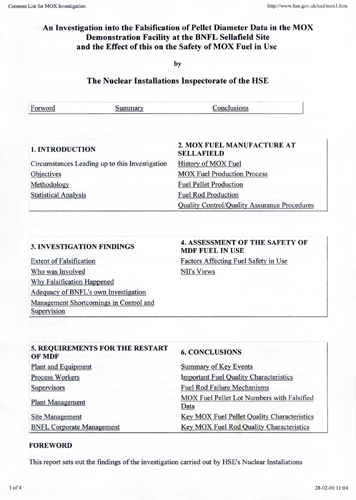 |
From the publication:
SUMMARY

The MOX Demonstration Facility (MDF) at BNFL's Sellafield site manufactures
MOX (mixed oxides of plutonium and uranium) fuel pellets and assembles these
using various customer supplied components to make complete fuel assemblies for
use in nuclear power reactors. Each fuel pellet produced passes through a fully
automated laser micrometer which checks and records the pellet's diameter at three
points along its length, giving a 100% automatic check on all pellets used in a fuel
rod. Any undersized or oversized pellets are automatically rejected. Those which
fall within the specified diametral tolerance pass onto the next stage where each
undergoes further visual checks. As a confirmatory check on diameter and in
accordance with the 1% Acceptable Quality Level (AQL) criterion set out in BS 6001,
a sample of 200 pellets (approximately 5%) which have passed through both these
stages is measured for a second time. This quality check is done using a similar
micrometer, but the sample pellets are presented to the micrometer by process
workers who type each measured diameter, e.g. 8.195mm, into a computer
spreadsheet.

On 20 August 1999 a member of MDF's Quality Control Team identified similarities
between the secondary pellet diameter data for successive Lots. After further
investigations, on 10 September 1999 BNFL reported to NII that some of these
secondary pellet diameter checks on the fuel manufactured for a Japanese customer
appeared to have been falsified by copying some data between spreadsheets.

The Health and Safety Executive's Nuclear Installations Inspectorate (NII) promptly
launched an investigation to establish both the extent of the falsification and the
causes of the event. NII concluded that data had indeed been falsified but that this
would not affect the safety performance of the fuel, given the automated primary
diameter check on 100% of the pellets used in each fuel rod.
This publication is only available at Laka on paper, not as pdf.
You can borrow the publication or request a copy. When we're available, this is possible for a small fee.