
Publication Laka-library:
Half life. Living with the effects of nuclear waste (Photobook) (2002)
| Author | R.Knoth, A.de Jong |
| Date | May 2002 |
| Classification | 2.34.8.80/23 (RUSSIA - MAYAK/CHELYABINSK (incl. Disaster Kyshtym Urals 1957)) |
| Remarks | A Russian edition 'Это не жизнь! Жизнь, отравленная радиоактивными отходами' is available at 2.34.8.80/11 |
| Front | 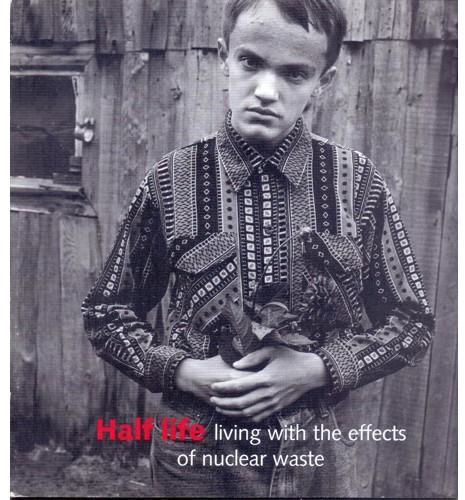 |
From the publication:
Foreword

Mayak, in Russia's Ural mountains, is the largest nuclear complex in the world. It is
the size of a small city. It lies 1400km east of Moscow, close to the Kazakstan border,
and has been the key Soviet and Russian facility for the production of weapons
plutonium and reprocessing of spent nuclear fuel since 1945. Mayak has blighted
the lives of the communities in its shadow. Accidental or deliberate releases of
radioactive material have exposed around 272,000 people to high levels of radiation.
Thousands have died, and many more live with its debilitating legacy.
The village of Muslomovo, some 30km from Mayak, is at the heart of the tragedy.
Here, the vast majority of the 2,500 villagers suffer from at least five chronic diseases
such as heart disease, high blood pressure, arthritis and asthma. Approximately half
the women and men are sterile. One-third of the babies have some physical disorder,
and almost 10 per cent are born prematurely. There has been a dramatic rise in
leukemia as well as in the number of people dying of cancers of the digestive
system, skin, bones and lungs. But behind these statistics are real people.
Robert Knoth's black and white photographs of Muslomovo and neighbouring
communities capture the ordinariness and lack of drama of day-to-day life, and move
effortlessly between the street and the home. Punctuating the social documentary are
his 6x6 portraits, shot in classic 'Soviet' style - square framed, straight to camera.
These could be family portraits taken at any time over the last fifty years. We are
reminded for an instant of the photography of August Sander and his portraits of
German society in the early twentieth century. But this is far from a 'normal'
community. In front of a bare blackboard, a young girl's arm hangs limply and
slightly hidden. A farm worker in the field is portrayed proud against the sky but is
supported by crutches. A lone woman walks across a desolate main square.
Knoth's images show us, without overemphasis on personal style and technique, the
life of a people living with the effects of nuclear waste. A half life.

John Novis, Head of Photography, Greenpeace International
This publication is only available at Laka on paper, not as pdf.
You can borrow the publication or request a copy. When we're available, this is possible for a small fee.