
Publicatie Laka-bibliotheek:
Bonn & the bomb (1995)
| Auteur | M.Küntzel |
| Datum | 1995 |
| Classificatie | 2.01.3.10/19 (DUITSLAND - ONTWIKKELING A-BOM / PLUTONIUMEKONOMIE) |
| Opmerking | also available in German 2.01.3.10/12 |
| Voorkant | 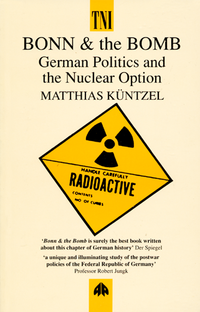 |
Uit de publicatie:
Foreword

Nuclear proliferation after the end of the Cold War has rapidly become one of the
major challenges to international peace and security. Traditional analysis tends to
highlight the so-called 'threshold states' (in recent years Iraq, and currently the
Democratic Peoples Republic of Korea and Iran); the recent cases of nuclear
smuggling, including plutonium, have further raised the proliferation issue to new
heights. This view of proliferation, selective and dangerously deceptive as it is, will
unfortunately be most widespread during the debate on the future of the Treaty for
the Non-Proliferation of Nuclear Weapons, or NPT, a decision on which will be
made in 1995.
Fortunately, and at a most appropriate time, Matthias Küntzel has sought to redress
the imbalance in the proliferation debate by focusing on the Federal Republic of
Germany, a country which has both the technical and financial means to 'go nuclear',
and in addition, has had a historical record on non-proliferation that at the very least
is ambiguous. The book tracks the development of the nuclear programme of
Germany, from the 1940s to the present. Of particular interest is the relationship
between the Federal Republic and the international community during the 1960s,
a time when there was considerable ambiguity over the former's intentions and
efforts were being made to conclude a draft NPT.
It will be difficult for Kuntzel's critics to reject the accuracy and implications of his
analysis. Indeed in the past his analysis was almost formal policy as far as the major
powers were concerned. As the author reminds us, the leading advocates of the NPT
in the 1960s were the principal allies of the 1939-45 war: the United States, Britain
and the Soviet Union. Their priority at that time was to establish a regime to deter
nuclear weapons development in two of the former axis powers: the Federal
Republic and Japan. Whereas today the threshold states are considered to be in the
Middle East or on the Korean peninsula, it was these two states that were of primary
consideration three decades ago. Kuntzel details efforts by the Federal Republic to
dilute the effectiveness of the NPT and internal political resistance to treaty
ratification.
Deze publicatie is alleen op papier bij Laka beschikbaar, niet als pdf.
Publicaties zijn te leen of informeer of we een kopie kunnen maken. Soms, als we tijd hebben, lukt dat tegen kostprijs van de kopieën.