
Publicatie Laka-bibliotheek:
Radioactive waste - Where next? (1997)
| Auteur | Office of Science and Technology |
| Datum | november 1997 |
| Classificatie | 2.05.4.10/50 (GROOT-BRITTANNIË - AFVAL) |
| Voorkant | 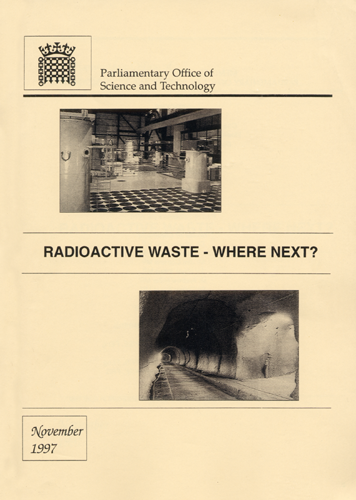 |
Uit de publicatie:
1 INTRODUCTION

The decision to develop a long-term solution for the disposal of solid radioactive
waste goes back to the 1976 report by the Royal Commission on Environmental
Pollution (the Flowers Report) which recommended that a national disposal facility
should be built and operated by a Nuclear Waste Disposal Corporation accountable
to the Secretary of State for the Environment (1). Subsequent to these
recommendations, in 1982, the Government established the Nuclear Industry
Radioactive Waste Management Executive initially as NIREX, but established as UK
Nirex Ltd in 1985. After several years of site evaluation and public debate, Nirex
selected Sellafield as its preferred option for the investigations for the site of a
deep repository for the disposal of radioactive waste in 1991. A year later, Nirex
announced that it wished to build a Rock Characterisation Facility (RCF) at Sellafield
to investigate the geology and groundwater regimes in the vicinity of the proposed
repository in more detail. The company's planning application for the RCF was
refused by Cumbria County Council and this was upheld on appeal by the Secretary
of State in March 1997 (2). Nirex decided not to challenge the Secretary of State's
decision (3). Meanwhile, radioactive waste continues to be generated at nuclear
power stations, at British Nuclear Fuels plc (generally known as BNFL) facilities,
by the UKAEA and MoD, in hospitals, laboratories and from other activities.

The present situation is that since sea disposal of solid radioactive waste was
discontinued in 1983, the only disposal option available has been for wastes with
low-level activity, which can be buried at the Drigg facility near Sellafield. Other
radioactive waste remains in storage pending a final disposal route, at a number of
sites around the UK (mostly at BNFL at Sellafield, but also at nuclear power stations,
UKAEA and MoD sites). It had been intended that the largest part of this (wastes with
intermediate level activity) would progressively be transferred to a deep repository
operated by Nirex from about 2015 onwards, but with the suspension of these plans,
existing and future waste arisings will need to be stored beyond that date, pending
the development of a new long-term management and disposal strategy for these
wastes. The refusal of planning permission for the RCF has thus created something
of a hiatus in the search for viable long-term options, and its implications are now
being assessed by the Department of the Environment Transport and the Regions
(DETR), with advice of the Radioactive Waste Management Advisory Committee
(RWMAC), the Environment Agency and other bodies. As RWMAC noted in its
1997 annual report (4), fundamental questions have been raised about how a
repository site might be chosen, but after the failure of Nirex' s initial strategy
for developing an acceptable disposal facility, many see a need for a new, wider
approach to develop a consensus on a safe and effective means of dealing with
these wastes.
Deze publicatie is alleen op papier bij Laka beschikbaar, niet als pdf.
Publicaties zijn te leen of informeer of we een kopie kunnen maken. Soms, als we tijd hebben, lukt dat tegen kostprijs van de kopieën.