
Publicatie Laka-bibliotheek:
Partnership under pressure (1989)
| Auteur | OTA |
| Datum | 1989 |
| Classificatie | 3.01.4.10/25 (VS - AFVAL) |
| Voorkant | 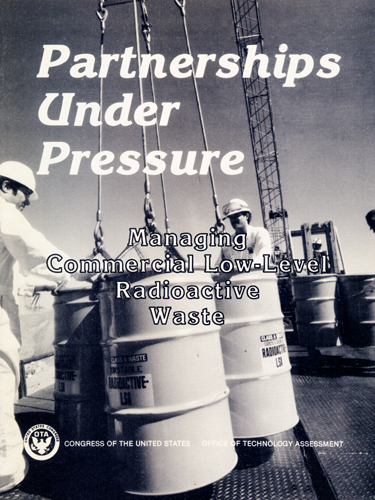 |
Uit de publicatie:
Foreword

Almost 5 years have passed since the Low-Level Radioactive Waste Policy
Amendments Act was enacted. The law establishes milestones and deadlines for
States to develop disposal facilities for their low-level radioactive waste (LLW).
Partnerships between States, called compacts, are encouraged to develop these
facilities because of the small national volume of LLW. While most States and
compacts are on track for developing facilities for most of their LLW, few States are
far along in developing disposal capacity for mixtures of low-level and hazardous
waste-so-called ''mixed LLW. ''

OTA's study on managing LLW, including mixed LLW, was undertaken at the
request of the Senate Committee on Environment and Public Works. The Committee
asked OTA to analyze States' progress in developing disposal facilities for LLW and
mixed LLW and to evaluate any existing problems in managing mixed LLW.

This report provides an overview of progress made by nine compacts and the
remaining unaffiliated States in developing disposal facilities. Disposal costs have
more than tripled while LLW volumes have dropped by more than half over the last
decade. Since many costs associated with developing and operating a disposal facility
are fixed, unit disposal costs will increase substantially as new facilities open.
This may lead States to consider the economics of cooperative arrangements,
which would permit them to trade waste services and construct fewer full-service
disposal facilities.

A small percent of LLW is labeled mixed LLW because it also contains components
classified as hazardous under the Resource Conservation and Recovery Act.
Jurisdiction over mixed LLW disposal falls jointly to the Nuclear Regulatory
Commission and the Environmental Protection Agency. Unfortunately, some
regulations aimed at mixed LLW are unattainable, inconsistent, or duplicative. Unless
current regulations are revised, generators of mixed LLW (e.g., industries, hospitals,
nuclear power plants, and laboratories) are left with three options: stop producing
the waste (which can mean going out of business), illegally store the waste, or
illegally dispose of the waste. Our report presents options on how this dilemma
may be addressed.

Substantial assistance was received from many organizations and individuals during
the course of this study. We would like to express our thanks to our advisory panel,
contractors, workshop participants, and reviewers who provided advice and
information throughout the course of this study. As with all OTA studies, OTA
remains solely responsible for the contents of this report.

John H. Gibbons
Director
Deze publicatie is alleen op papier bij Laka beschikbaar, niet als pdf.
Publicaties zijn te leen of informeer of we een kopie kunnen maken. Soms, als we tijd hebben, lukt dat tegen kostprijs van de kopieën.