
Publicatie Laka-bibliotheek:
The Mapoon story by the Mapoon people. Book One (1975)
| Auteur | Int. Development Action |
| Datum | 1975 |
| Classificatie | 4.22.5.19/01 (AUSTRALIË - MIJNEN - REST MIJNEN) |
| Voorkant | 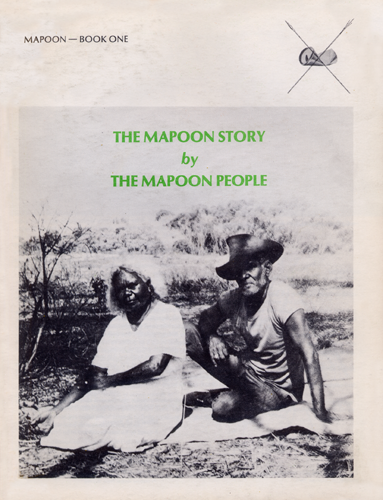 |
Uit de publicatie:
Introduction

This is the story of Mapoon according to the Aboriginal people of Mapoon as they
wrote and recorded it in the Dry Season of 1974 and the Wet Season of early 1975.
There was at Mapoon at that time about six families, pioneering the rebuilding of
their destroyed settlement, planting gardens, hunting and fishing, preparing for the
day when the rest of their people could return from exile to their homes.
Among these six families there were Elders of the tribes which gathered at Mapoon
in the early days of the Mission. There was Frank Don, Simon and Rachel Peter of
the Tjungundji Tribe who belong to the South side of the great Port Musgrove
harbour and the mouth of the Batavia River (1). Jerry Hudson and Norman Wheeler,
too, belong to the Tjungundji by birth and adoption; from the Yupungatti tribe of
Coen River (2) just to the South comes Mrs Jimmy; from the Tanikutti tribe who
belong to Pine River further to the South comes Harry Toeboy and Gilbert Jimmy
as well as Jessie Wheeler.
These are the river people of Mapoon and, from time immemorial, they have
known each other, married each other, celebrated together and hunted together
on their land, rivers and sea.
This is their story of their law and customs, their struggle against the White
invaders for their land, their loss of it to the mission and to the mining companies
and of the burning to the ground of their mission-settlement in 1963. It is the story
too of their re-possession of their land in 1974, their current struggles and their
hopes for the future. It is taken from their writings and tapes and is in their
ownwords.Simon Peter of the Tjungundji said: "I want everybody to read it for
themselves. Read it so they can know what's happening in old Mapoon today."
Deze publicatie is alleen op papier bij Laka beschikbaar, niet als pdf.
Publicaties zijn te leen of informeer of we een kopie kunnen maken. Soms, als we tijd hebben, lukt dat tegen kostprijs van de kopieën.