
Publicatie Laka-bibliotheek:
Proceedings of the first international congress on uranium mining Saskatoon, Saskatchewan Canada, June 16-21, 1988 (1988)
| Auteur | Stop it at the source |
 | 6-09-0-00-65.pdf |
| Datum | juni 1988 |
| Classificatie | 6.09.0.00/65 (VERZET INTERNATIONAAL - ALGEMEEN) |
| Voorkant | 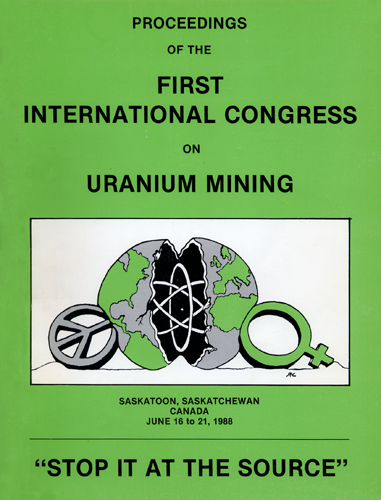 |
Uit de publicatie:
F O R E W O R D

It was appropriate to convene the First International Uranium Congress in
Saskatchewan, Canada. Canada produces more uranium than any other country
and the bulk of this now comes from Northern Saskatchewan. Saskatoon,
Saskatchewan - where the Congress was held - has come to be known as the
capital of the multinational uranium industry.

Names of mines which have opened in recent years, such as Cluff Lake and Key
Lake, have become well known around the world. And now, a new name - Cigar
Lake - is about to be added to this list. Cigar Lake has the most concentrated body
of uranium ore in the world - so concentrated, in fact, that the mining may have to
be done by remote control robotic machines.

Industry and government refer to Northern Saskatchewan as the Persian Gulf of
uranium. In their quest for profit and non-renewable energy they largely ignore
the environmental and social impacts of megatonnes of uranium mine tailings, an
impact we can only begin to estimate, and the awesome responsibility of becoming
the primary source of the fuel for nuclear power plants and the high-level
radioactive wastes and weapons grade material which comes with this activity.

Saskatchewan environment, development and peace groups have been fighting the
expansion of uranium mining for over a decade. This alliance helped stop Eldorado's
proposed uranium refinery at Warman, near Saskatoon, in 1980. While many minds
have been changed, the powers of government and the corporations have allowed
them to carry through their plans through the use of biased inquiries, millions of
dollars of "public relations" activities, and false promises about jobs and
opportunities to the aboriginal people of the North. Millions of dollars of public
money have been spent to assist the corporations in their exploitation of the North.

Over the last few years strong political links have been made between people
opposing uranium mining here and abroad. Special links have been established with
groups in countries importing Saskatchewan uranium, including Japan and countries
in Western Europe and Scandinavia. In the spring of 1987, at a conference in Brussels
on the effects of the Chernobyl nuclear disaster, which two Saskatchewan activists
attended, the idea was conceived of having an international conference on the
uranium issue in Saskatchewan to which people opposing the uranium and nuclear
industry could come from several regions of the world.