
Publicatie Laka-bibliotheek:
Chernobyl: Ten years of disaster. Possibility and necessity of phase-out of Chernobyl (1996)
| Auteur | WISE Nuclear Monitor |
| Datum | april 1996 |
| Classificatie | 2.41.0.00/06 (OEKRAÏNE - ALGEMEEN) |
| Voorkant | 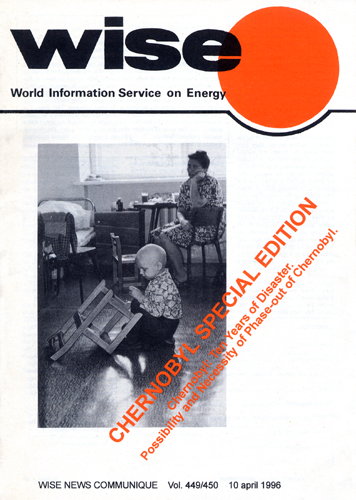 |
Uit de publicatie:
INTRODUCTION

On 26 April 1986, reactor 4 of the Chernobyl Nuclear Power Plant exploded (see
box 1). Radioactive fallout from Chernobyl spread throughout Europe and even
reached Japan and the United States. Nearly 400,000 people were evacuated.
According to a recent United Nations document, nine million people were affected
by radiation in one way or another. The most affected were the so-called liquidators
(numbering about 800,000) who did the cleanup work.

The fires of Chernobyl bode ill for the future of nuclear energy. They have burnt
down the dreams and wishful thinking of those who see the number of reactors
continuing to grow in every country. In the 80s, the nuclear industry already seemed
to be in crisis. The disaster at Harrisburg (US) in March 1979 marked the beginning
of the great economic catastrophes of the nuclear power industry in the US. In
Nucleonics Week (4 July, 1985), Jack H. Ferguson, president of Virginia Power
Company, admitted: "We consider nuclear power an option in the near term. And I
think I'd have to say near term is probably the next ten or fifteen years. We don't
think public perception will permit it much sooner than that. ... "

Before the disaster of Chernobyl, little was known about the Chernobyl RMBK-type
reactor in the Western world. The nuclear industry was convinced they were safe (see
the IAEA-quotations in box 2). The nuclear industry as well as politicians worldwide
immediately reacted to the Chernobyl disaster by calling for an end to the Soviet-type
reactors in Central and Eastern Europe. Ten years later, we can very well see that
this has not come true. The discussion on nuclear power plants in Eastern Europe has
shifted from the immediate closure of the plants to ways of upgrading them. The
nuclear industry has also started programs for the extension of reactors' lifetimes.
This can be seen as a way to try to survive with the slackening of new construction
orders. Economic reasons take precedence before safety.
Deze publicatie is alleen op papier bij Laka beschikbaar, niet als pdf.
Publicaties zijn te leen of informeer of we een kopie kunnen maken. Soms, als we tijd hebben, lukt dat tegen kostprijs van de kopieën.